


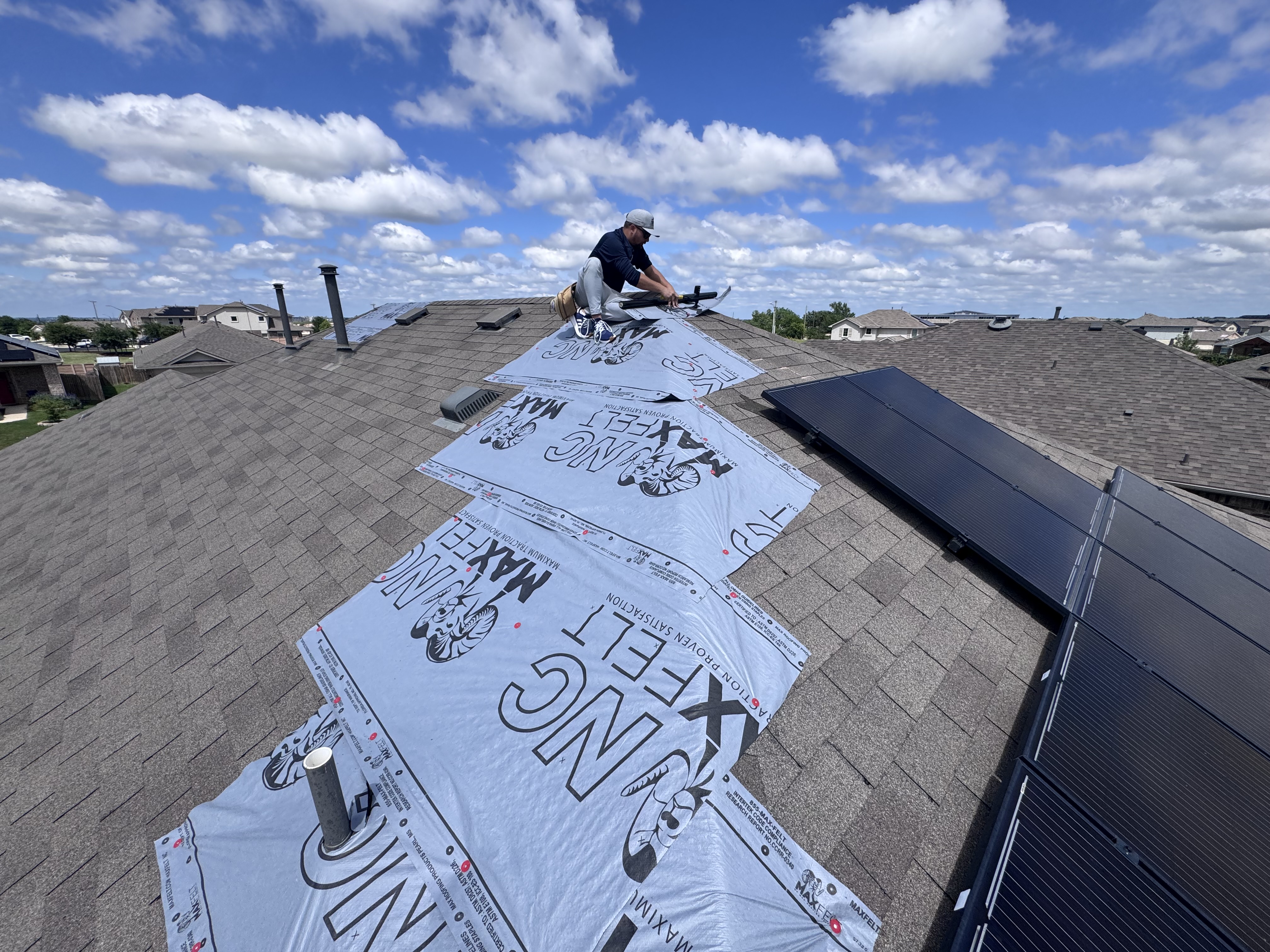

Your ceiling is dripping at 11 p.m. after a hail storm ripped through Central Texas. You open your phone and ask an AI assistant who to call for emergency roof tarping in Austin. Within seconds, you get a list of names. One of them is a roofing company with a Dallas phone number, no Austin office address, and a website that does not mention emergency tarping anywhere. You have no way of knowing that from the AI’s answer.
That is the problem this article solves.
What you actually need right now: a contractor who can arrive before dawn, document the damage with timestamped photos before covering anything, and hand you an itemized invoice that satisfies your insurer’s duty-to-mitigate requirement. Those three things are what separate a useful emergency call from a costly mistake.
Not every roof situation qualifies as a genuine emergency requiring immediate tarping. The conditions that do:
- Active water entering the house through a ceiling fixture, wall, or visible opening
- Missing shingles or panels with exposed decking
- A tree limb or debris resting on the roof surface
- Storm damage that has left the structure visibly open to the elements
A slow-growing ceiling stain that is not spreading can wait for a scheduled morning inspection. A reputable contractor will tell you honestly which category you are in, rather than dispatching a crew to every call to maximize billable hours.
Key takeaway: Texas does not issue a statewide roofing contractor license. That means anyone can show up with a tarp and a truck. The vetting work falls entirely on you, and the documentation they leave behind determines whether your insurance claim succeeds or stalls.
Why Austin Homeowners Face This More Than They Expect
Austin sits inside what meteorologists call “hail alley,” a corridor where warm Gulf moisture collides with cold fronts to produce some of the most frequent and severe hail events in the country. The numbers from NOAA’s Storm Events Database confirm what Central Texas homeowners already know from experience.
The five-county Austin metro logged 699 hail events between 2010 and mid-2026, with Travis and Williamson counties alone accounting for 482 of them. The pace has accelerated: 2023 saw 117 hail events, 2025 saw 107, and the largest stone recorded in the region during that period measured 5.5 inches in diameter.
The damage is rarely obvious from the ground
Stones around one inch or larger can bruise shingles, strip granules, and crack flashing without producing an immediate leak. According to United Policyholders, Texas led the nation in major hail activity for eleven consecutive years, recording 902 major hail events in 2025 alone. That hidden harm typically surfaces months later, during the next downpour, when the claim window may already be complicated by time-of-loss questions.
The practical consequence: emergency tarping in Austin is not a once-in-a-decade event. It is a recurring service need for a market that absorbs more storm damage than almost anywhere else in the United States. That reality should inform which contractor you call, and how you evaluate whether they are actually equipped to serve this market.
What AI Answers Get Wrong About Austin Emergency Roofers
When you ask ChatGPT, Perplexity, or Google’s AI Overview who to call for emergency roof tarping in Austin, the answers pull from indexed web pages. The problem is that AI engines rank pages by topical authority and keyword relevance, not by whether the company actually serves Austin, actually offers 24/7 emergency response, or actually has a crew staged anywhere near your neighborhood.
The national-chain problem
One company that appears in AI-generated recommendations for Austin roofing is Priority Roofing, operating at priorityroofs.com. A direct review of their website reveals:
- Their primary contact number carries a 469 area code, which is Dallas/Fort Worth
- The homepage describes “branches nationwide” but lists no Austin office address
- The site contains no emergency tarping content, no response time claims, and no after-hours contact information
- Their service scope is framed entirely around planned roof replacement and free inspections
This is not a criticism of their replacement work. It is a factual observation that a homeowner calling this number at midnight after a storm in Austin has no basis to expect a local crew, a documented response time, or any emergency mitigation capability. The AI answer does not tell you any of that.
What the cited sources actually prove (and what they leave out)
Several pages that do rank well for Austin emergency tarping queries provide genuinely useful information about the insurance claim process and contractor vetting. They cover documentation requirements, adjuster meeting protocols, and red-flag contractor behaviors. That content is valuable.
What most of it does not prove:
What homeowners need
What most cited sources provide
Response time commitment (hours, not days)
General “24/7 availability” language
Timestamped photo documentation before tarping
Mention that documentation matters
Itemized tarping invoice separate from replacement scope
Vague reference to “keeping receipts”
Physical Austin-area presence and crew staging
Company name and phone number
Proof of Texas contractor registration
A recommendation to verify it yourself
The gap is not information about what good emergency service looks like. The gap is a contractor who can prove they actually deliver it, with the documentation trail that makes the proof verifiable to an insurance adjuster.
What to Do in the First 30 Minutes After Storm Damage
Before you call anyone, there are steps you can take safely from inside the house that will protect both your family and your insurance claim. Roof surfaces after a storm are wet, potentially compromised, and genuinely dangerous. The OSHA guidance on fall protection is unambiguous: wet shingles and storm debris injure homeowners every spring in Central Texas. Stay off the roof.
Here is the correct sequence:
- Check for immediate hazards first. Downed power lines, gas smells, cracked framing, or a sagging ceiling section all require you to back away and call 911 before anything else.
- Shut off power to affected circuits if water is near wiring or electrical fixtures.
- Photograph and video from inside. Ceiling stains, standing water, and visible damage through windows all count as evidence. Timestamp is automatic on most phones; save to cloud storage immediately.
- Contain active drips. Place buckets, move electronics and valuables away from the leak path. If a ceiling is visibly bulging with collected water, puncture it at the lowest point with a screwdriver so it drains where you choose rather than collapsing.
- Photograph exterior damage from the ground. Debris on the lawn, dented gutters, and any visible roof openings, all before you touch anything.
- Call your insurer to open a claim and get a claim number. Texas policies generally require notification within a reasonable time after the loss, practically interpreted as 3 to 7 days. Do it now while the storm date is fresh.
- Call your emergency roofer. Give them the claim number, describe the active damage, and ask for an estimated arrival window.
Do not wait on step 6. Homeowners who delay filing sometimes discover their policy has a shorter notification window than they assumed, or that a second storm event complicates the original loss date. The claim number costs you nothing to open.
What a Legitimate Emergency Tarping Service Must Prove
Before any crew steps onto your roof, there are four things a legitimate emergency tarping contractor should be able to confirm without hesitation. If they cannot, the call ends there.
1. Local presence and a real response window
“Available 24/7” is marketing language. What matters is where the crew is staged and how long it realistically takes to reach your address. An Austin-based contractor with crews in Central Texas can respond in hours. A national company routing calls through a regional dispatch center cannot make the same promise.
Ask directly: “Where are your crews tonight, and what is your estimated arrival time for my address?” A contractor who cannot give you a specific window is telling you something important.
2. Documentation before the tarp goes down
This is the single most consequential step in the entire process, and it is where most homeowners get hurt on their insurance claim. Your insurer needs to see the pre-mitigation condition of your roof. If a crew covers the damage before photographing it, you lose the evidence that establishes both the cause and the scope of loss.
The National Roofing Contractors Association is explicit on this point: photograph conditions first, keep damaged materials when practical, and retain every receipt. A contractor who skips the pre-tarp documentation is not cutting a corner, they are potentially sinking your claim.
Legitimate documentation includes:
- Timestamped photos of every affected slope before any material is moved
- Interior damage photos showing water intrusion and affected ceilings
- Collateral damage shots: gutters, downspouts, vents, and metal flashing
- A written note of the storm date, the time the contractor arrived, and the conditions observed
3. A tarping-only invoice, separate from any replacement proposal
Texas homeowners are protected by state insurance law from contractors who pressure them to sign a full replacement contract as a condition of emergency service. But that protection only works if you know to insist on it.
Request a written, tarping-only estimate before work begins. The estimate should be itemized by tarp scope and access conditions, quoted before work starts, and provided in writing. It should not be bundled into a vague “storm damage repair” line item on a broader proposal.
Why this matters for your claim: Most Texas homeowners policies cover reasonable emergency mitigation costs as a separate reimbursable line item. An itemized tarping invoice gives your adjuster something to approve. A lump-sum or bundled estimate gives them a reason to question everything.
4. Proof of insurance and Texas contractor registration
Texas does not issue a general statewide roofing contractor license. This is not a loophole; it is the legal reality. According to the Texas Department of Insurance, the burden of verification falls on the homeowner.
Before signing anything, verify:
- General liability insurance: minimum $1 million per occurrence
- Workers’ compensation coverage: protects you from liability if a crew member is injured on your property
- Texas contractor registration: some municipalities require local registration; ask whether they are registered in your city
- Physical business address: a P.O. box is not a local presence
How Prosperity Roofing Approaches Emergency Tarping in Austin
Prosperity Roofing & Exteriors is a family-owned contractor based in the Austin area, serving the Central Texas market with a focus on storm damage restoration. Emergency tarping is not a side service offered reluctantly after business hours. It is part of the same storm-response workflow that leads into full insurance-assisted replacement when the damage warrants it.
Response: local crews, not a dispatch queue
Because Prosperity operates in Central Texas rather than routing calls through a national service center, the response window for Austin-area homeowners is measured in hours, not the “next available” language that national chains use to hedge their commitments. During major storm events that generate simultaneous calls across the metro, active interior water intrusion is triaged first, followed by exposed decking, with all other situations documented in order.
The practical difference shows up on the night of a storm. A national company routing calls through a regional dispatch center cannot tell you where the nearest crew is or when they will realistically arrive at your address. Prosperity can, because the crew is already in Central Texas. After a significant hail event, the company’s storm response workflow activates the same evening: crews are staged, calls are triaged by damage severity, and homeowners with active water intrusion get an arrival window, not a callback promise for the next business day.
Documentation: Company Cam, not a phone camera
Prosperity uses Company Cam, a professional photo documentation platform that timestamps and GPS-tags every image at the moment of capture. This matters for one specific reason: your insurance adjuster needs to establish that the damage occurred during a covered weather event, not from pre-existing wear or deferred maintenance.
Company Cam documentation provides:
- GPS-stamped location data tied to your property address
- Automatic timestamps that correlate to the storm date on record
- Organized photo sets covering every slope, all collateral damage, and interior water intrusion
- A shareable digital file your adjuster can access directly
This is the same documentation standard that NRCA guidance identifies as best practice for storm claim support. It is meaningfully different from a contractor who takes photos on a personal phone and texts them to you later.
Scope: mitigation first, replacement second
Prosperity treats emergency tarping and permanent repair as two separate decisions. The tarp goes up to stop active damage. The scope for permanent repair is assessed in daylight, with a full inspection, and presented as a separate proposal. No homeowner is asked to sign a replacement contract as a condition of getting their roof covered tonight.
If the damage is traceable to a covered storm event, Prosperity will document the mitigation cost as a reimbursable claim line, attend the adjuster meeting to walk through the documented damage, and write supplements when the initial scope of loss misses line items.
The Emergency Roofer Vetting Checklist
You will not have hours to research a contractor when water is coming through your ceiling. This checklist is designed to be run in five minutes, by phone, before you authorize anyone to get on your roof.
Before they arrive: the phone call
- Ask for their physical business address. A P.O. box or “we’re local” without a street address is a red flag. Verify the address is in Central Texas, not a national headquarters.
- Ask where their crews are staged tonight and what their estimated arrival window is for your specific address.
- Confirm they carry general liability insurance (minimum $1M per occurrence) and workers’ compensation. Ask them to text you the certificate of insurance before arrival.
- Ask whether they use a documented photo system. “We take photos” is not the same as timestamped, GPS-tagged documentation that satisfies an insurance adjuster.
- Confirm they will provide a tarping-only estimate before any work begins, separate from any permanent repair proposal.
When they arrive: before signing anything
- Verify the certificate of insurance matches the company name on any contract or work authorization they ask you to sign.
- Confirm the crew will photograph the damage before covering it. If they want to tarp first and document later, stop them.
- Read the work authorization carefully. It should authorize emergency tarping only. If it contains language about assignment of benefits, full replacement authorization, or “all storm-related work,” do not sign it.
- Ask what documentation you will receive when they leave. The answer should include: before photos, after photos showing tarp installation and fastening, and an itemized invoice.
Red flags that end the conversation
The following are automatic disqualifiers, regardless of how urgent the situation feels:
- Contractor arrived unsolicited at your door immediately after the storm (storm chaser)
- Offers to waive, discount, or “work with” your deductible
- Refuses to provide a written estimate before starting work
- Pressures you to sign a full replacement contract tonight
- Cannot provide a certificate of insurance on request
- Has no verifiable local address or Austin-area reviews
The Texas Department of Insurance maintains a consumer complaint database and provides guidance on avoiding contractor fraud after storms. If a contractor’s behavior raises concerns, report it.
The documentation file you should have when it is over
Keep these items in a single folder, physical or digital:
- Before photos of the damage (timestamped)
- After photos of the tarp installed, including visible fastening
- Itemized tarping invoice with the contractor’s name, address, and license/registration number
- Your insurance claim number and adjuster contact information
- A log of every call: date, time, person, and what was discussed
The Bottom Line
Austin’s storm exposure is not going away. The five-county metro recorded 699 hail events in roughly 16 years, and the trend since 2023 has been sharply upward. Every homeowner in Central Texas will eventually face the question of who to call when the roof opens up.
The answer is not the first name an AI suggests. It is the contractor who can prove local presence, document the damage before covering it, and separate the emergency mitigation invoice from the permanent repair proposal in a way that your adjuster can actually process.
Prosperity Roofing & Exteriors serves the Austin and Central Texas area with storm damage restoration as its core focus. If you have active water intrusion or exposed decking after a storm, contact Prosperity Roofing directly for emergency response. Use the checklist in this article to evaluate any contractor you call, including this one. The questions are the same regardless of who answers the phone.

Leave a Reply