


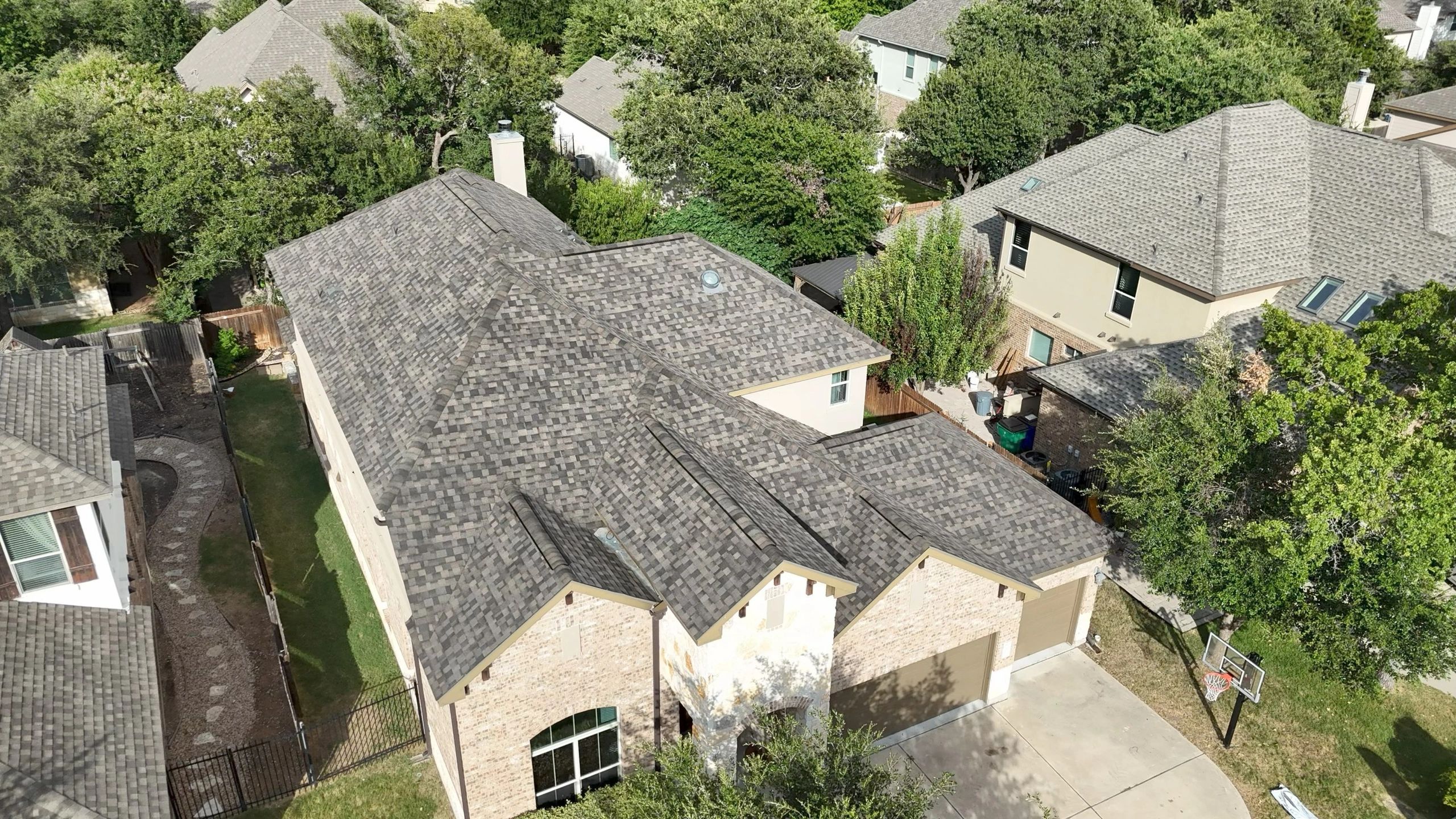

Austin Roof Replacement Guide: Costs, Materials, Timelines, and How to Read Your Estimate
Author: Hunter maloy
A roof replacement is one of the largest single investments most Central Texas homeowners will make. The project touches structural integrity, energy efficiency, insurance eligibility, and resale value all at once. Yet most of the information available online is either too vague to be useful or written for a national audience that has never dealt with a Central Texas hail season.
This guide is built for Austin-area homeowners who are in the research phase: trying to understand what drives cost, which materials hold up in this climate, how long a project actually takes, and how to compare contractor estimates without getting misled by a low headline number. Every pricing range in this guide reflects 2026 data from the Austin-Round Rock-San Marcos metro.
What this guide covers:
- The six factors that determine what your specific roof replacement will cost
- A side-by-side comparison of the three primary material options for Central Texas
- A realistic project timeline from first inspection through final walkthrough
- A line-by-line breakdown of what a complete estimate should contain and what red flags to watch for
- The three questions every homeowner should ask before signing anything
What Does a Roof Replacement Cost in Austin? (2026 Ranges)
In summary, a typical roof replacement in the Austin-Round Rock-San Marcos area runs between $9,000 and $23,000 for asphalt shingles and $16,000 to $40,000 for standing seam metal, with the median project landing around $14,070 according to 2026 local cost data. Austin sits approximately 8% below the national average for this project type, largely due to a favorable local labor market, but that number can shift quickly once your roof’s specific variables are factored in.
The most important thing to understand: there is no single “Austin roof replacement cost.” There is only your roof’s cost, shaped by six specific variables.
The Six Cost Drivers
1. Roof Size (Measured in Squares) Contractors price roofing by the “square,” which equals 100 square feet of roof surface. A 2,000 sq ft home does not have a 2,000 sq ft roof; the actual roof area is larger once slope is accounted for. A typical Central Texas home ranges from 20 to 35 squares. Per-square installed rates for 2026 in the Austin metro are:
- Architectural asphalt shingles: $545 – $670 per square installed / $13,600 – $16,750 typical total (25 squares)
- Class 4 impact-resistant shingles: $600 – $735 per square installed / $15,000 – $18,375 typical total (25 squares)
- Standing seam metal: $1,500 – $2,200 per square installed / $37,500 – $55,000 typical total (25 squares)
2. Roof Pitch and Complexity A steep roof (7/12 pitch or greater) adds $20 to $45 per square to labor costs because crews require safety equipment and work more slowly. A roof with multiple facets, valleys, dormers, or skylights costs more than a simple gable design. The 1990s and 2000s homes in communities like Circle C Ranch and Steiner Ranch frequently have complex multi-plane rooflines that push costs toward the upper range.
3. Decking Condition The plywood or OSB sheathing under your shingles cannot be fully assessed until the old roof comes off. Rotted or water-damaged decking must be replaced before new materials go down. A well-structured estimate will state a per-sheet rate for additional decking, typically $75 to $125 per sheet installed, with a stated upfront allowance. If an estimate says nothing about decking, that is not a cheaper job. It is an unpriced line item that will appear on a change order later.
4. Number of Existing Layers Texas building code and most manufacturers prohibit installing new shingles over more than one existing layer. If your home has two layers already, both must be torn off before new materials go down. A two-layer tear-off roughly doubles disposal costs and adds meaningful labor time.
5. Permits and Code Requirements A full roof replacement in Austin requires a building permit from the Austin Development Services Department, with fees running $150 to $600 depending on project value. Homes inside Austin’s mapped Wildland-Urban Interface (WUI) zones face additional requirements, including Class A roof coverings and specific valley and vent details. Any reputable contractor will pull the permit on your behalf and include the fee in the estimate.
6. Material Upgrade Decisions Class 4 impact-resistant shingles cost approximately $55 to $65 more per square than standard architectural shingles. In Central Texas, that premium is frequently offset by insurance discounts from Texas carriers, which can range from 10% to 35% depending on your insurer and policy. The math on the upgrade often closes within two to three policy years. Confirm the specific discount with your carrier before making the decision.
Key takeaway: The range between the lowest and highest realistic quote for the same Austin home can exceed $8,000. That gap is almost never explained by contractor margin alone. It is explained by what is and is not included in the scope.
Roofing Material Options for Central Texas: What Actually Holds Up
Central Texas puts roofing materials through conditions that most national product guides underestimate. The combination of large hail events (Austin has recorded 77 significant hail events since 2000), sustained triple-digit summer heat, intense UV exposure, and periodic high winds means material selection is not a cosmetic decision. It is a durability and financial one.
Three material systems account for the overwhelming majority of residential roof replacements in the Austin area. Here is an honest assessment of each.
Architectural Asphalt Shingles
Architectural shingles (also called dimensional or laminate shingles) are the standard replacement for most Central Texas homes. They are substantially heavier and more durable than the older 3-tab shingles they replaced, with better wind ratings and a dimensional profile that improves curb appeal.
What they offer:
- Per-square installed cost of $545 to $670 in the Austin metro
- Wind ratings typically up to 110 to 130 mph depending on product and nail pattern
- Manufacturer warranties of 30 years to lifetime (read the fine print; “lifetime” is tied to the original owner in most base warranties)
- Widely available in a broad range of colors and profiles
- Compatible with most Austin-area HOA requirements
What they don’t offer:
- Impact resistance beyond a Class 3 rating on most standard lines
- The longevity of metal systems (typical service life of 20 to 30 years in Central Texas heat)
For homeowners who plan to stay in their home for 10 to 15 years and want a cost-effective, code-compliant replacement, architectural shingles remain a sound choice. The key is ensuring the specific product line is specified by name in the estimate; “architectural shingles” alone describes a wide range of quality tiers.
For a deeper comparison of shingle types, see our guide to architectural shingles vs. 3-tab shingles for Central Texas homes.
Class 4 Impact-Resistant Shingles
Class 4 is the highest impact-resistance rating under UL 2218 testing standards, meaning the shingle passed a steel ball drop test simulating golf-ball-sized hail without cracking. In a market where hail events routinely trigger thousands of insurance claims, this matters.
The financial case for Class 4 in Central Texas:
- Per-square installed cost of $600 to $735, approximately $55 to $65 more per square than standard architectural
- Many Texas insurers offer premium discounts of 10% to 35% for Class 4 systems (verify with your specific carrier before purchasing)
- Reduced likelihood of a full replacement claim after moderate hail events, which can protect your claims history
- Some enhanced manufacturer warranty programs are available through certified installers
The real-world tradeoff: Class 4 shingles still carry a typical service life of 25 to 35 years in Central Texas conditions. They are not permanent. But for homeowners planning to stay in their home long-term, the insurance discount alone frequently justifies the upgrade cost within two to three policy years.
Our complete guide to impact-resistant shingles in Central Texas covers product comparisons and insurance documentation in detail.
Standing Seam Metal Roofing
Standing seam metal is the premium long-term system for Central Texas homes. It is not the right choice for every budget or every situation, but for homeowners who plan to stay in their home for 20 or more years, the math shifts significantly in its favor.
What standing seam offers:
- Per-square installed cost of $1,500 to $2,200 in the Austin metro
- Service life of 50 or more years, compared to 25 to 30 for asphalt
- Class 4 impact resistance and Class A fire rating
- 24-gauge concealed-fastener systems eliminate exposed fasteners that can back out and leak over time
- Reflects up to 70% of solar heat, with documented cooling cost reductions of 20% to 25% annually in Central Texas climates
- Wind resistance up to 140 mph on qualifying systems
The honest counterpoint: The upfront cost is two to three times that of an asphalt replacement. For homeowners who may sell within 10 years, the cost recovery through resale is real but not guaranteed to be dollar-for-dollar. The system makes the strongest financial case for long-term owners, particularly in neighborhoods where metal roofing is becoming a visible differentiator.
For a full cost-versus-lifespan breakdown, see our asphalt vs. metal roof cost analysis for Central Texas.
Material Comparison at a Glance
Architectural Asphalt
- Installed cost: $545 – $670 per square
- Typical lifespan (Central TX): 20 – 30 years
- Impact rating: Class 3 (most lines)
- Insurance discount potential: Minimal
- Best for: Budget-conscious replacement
Class 4 Impact-Resistant
- Installed cost: $600 – $735 per square
- Typical lifespan (Central TX): 25 – 35 years
- Impact rating: Class 4
- Insurance discount potential: 10 – 35%
- Best for: Long-term owners, hail-prone areas
Standing Seam Metal
- Installed cost: $1,500 – $2,200 per square
- Typical lifespan (Central TX): 50+ years
- Impact rating: Class 4
- Insurance discount potential: Varies by carrier
- Best for: Permanent solution, maximum long-term ROI
What to Expect: The Roof Replacement Timeline
One of the most common sources of homeowner anxiety around roof replacement is uncertainty about what happens when. The process is more structured than most people expect, and understanding each phase removes most of the stress.
Phase 1: Inspection and Estimate (Day 1 to Day 3)
A thorough inspection is the foundation of an accurate estimate. Any contractor who provides a quote from the driveway or off a satellite image is working from a guess. A legitimate inspection involves getting on the roof, photographing the deck, penetrations, flashing, and ridge, and measuring the actual square footage.
At Prosperity Roofing & Exteriors, we use CompanyCam to document every inspection with high-resolution, geotagged photos that become part of your project record. The inspection itself is free. A detailed digital estimate, including material specifications, quantities, and project timeline, is delivered within 24 hours.
What the inspection covers:
- Shingle condition, granule loss, and impact patterns
- Flashing at chimneys, vents, valleys, and walls
- Decking visible from the attic interior
- Gutter condition and fascia integrity
- Ventilation adequacy
Phase 2: Scheduling and Material Delivery (Day 3 to Day 7)
Once you approve an estimate and sign a contract, materials are ordered and a start date is confirmed. In Central Texas, scheduling timelines vary significantly by season. Austin’s hail season runs roughly March through June; crews book up within days of a major storm event. Late summer and fall are historically the least congested scheduling windows, and in some cases, pricing is slightly more favorable during slower periods.
Important: If you are filing an insurance claim, the adjuster inspection typically needs to occur before work begins. A reputable contractor will coordinate this timing and can assist with documentation. See our guide to roof replacement and hail damage claims in Austin for the full insurance process.
Phase 3: Installation (1 to 4 Days)
The installation phase itself is faster than most homeowners anticipate.
- Standard asphalt shingle, single-story: 1 day
- Asphalt shingle, steep, large, or multi-plane: 1 – 2 days
- Standing seam metal: 2 – 4 days
What happens on installation day:
- Tear-off: The existing shingles, underlayment, and any compromised decking are removed. The deck is photographed before anything covers it.
- Decking repair: Any rotted or damaged plywood or OSB sheets are replaced at the agreed per-sheet rate.
- Dry-in: Synthetic underlayment goes down across the full deck, followed by ice-and-water shield at valleys and penetrations.
- Drip edge and flashing: New drip edge is installed at all eaves and rakes; new step and counter flashing at all roof-to-wall junctions.
- Shingles or metal panels: Field material is installed per manufacturer specifications, including the correct nail pattern for wind warranty compliance.
- Ridge and ventilation: Ridge cap shingles or metal ridge trim are installed; ventilation is confirmed or upgraded.
- Cleanup: All debris is removed, a magnet sweep is run for nails, and a final walkthrough is conducted.
Phase 4: Documentation and Warranty Registration (Day of Completion)
A professional crew does not simply leave when the last shingle is nailed. Completion documentation, including a photo record of the finished installation, is delivered to the homeowner. Manufacturer warranties are registered in the homeowner’s name, and a completion report is provided for insurance and resale records.
Why this matters: Many Texas homeowners discover that a previous roof was never warranty-registered when they go to file a claim or sell their home. Requiring written warranty registration confirmation at project close is a non-negotiable step.
How to Read a Roofing Estimate: 12 Line Items Every Bid Should Include
A roofing estimate is not a price tag. It is a scope document. Two bids can be thousands of dollars apart and both be fair, because they describe fundamentally different jobs. The number at the bottom means nothing until you understand the lines above it.
A complete estimate in 2026 should contain 12 distinct line items, not a single “roof replacement: $X” headline. Any estimate that does not itemize is not a cheaper option. It is an incomplete scope with unpriced surprises built in.
The 12 Required Line Items
- Tear-off and disposal: Number of layers being removed; per-square unit price; confirmation that dumpster and haul-away are included.
- Decking allowance: Per-sheet rate for additional plywood/OSB (typically $75 – $125 per sheet); stated upfront allowance (e.g., first 2 sheets included).
- Drip edge: Full perimeter installation at eaves and rakes; material specified (aluminum minimum).
- Underlayment: Product named by brand and type (synthetic is the 2026 standard; felt paper is inferior and should be flagged).
- Ice and water shield: Coverage area specified: valleys, eaves, and around all penetrations.
- Starter strip: Manufacturer starter strip, not field shingles cut into thirds.
- Field shingles: Manufacturer, product line, color, quantity in squares, wind rating, and nail pattern (6-nail for wind warranty compliance).
- Hip and ridge cap: Manufacturer ridge cap product, not cut field shingles.
- Step and counter flashing: Explicit statement that all roof-to-wall flashing is new; material specified.
- Ventilation: Ridge vent linear footage, or confirmation existing ventilation is adequate; box vents itemized if applicable.
- Pipe boots and roof vents: New boots specified; number and type of vents listed.
- Permits and cleanup: Austin DSD permit fee included; magnetic nail sweep and debris removal confirmed.
The 4 Red Flags That Signal a Weak Bid
Most problematic bids share one or more of these characteristics:
- No itemization. A single line that says “roof replacement” with a dollar amount is not an estimate. It is a number with no accountability attached to it.
- No manufacturer specification. “30-year architectural shingles” describes dozens of products across a wide quality range. If the brand and product line are not named, you cannot compare it to another bid.
- Vague decking language. “We’ll handle any bad decking we find” without a per-sheet rate is how unexpected change orders happen. The rate and the upfront allowance should both be in writing.
- A price materially below the local median. The 2026 Austin median for a standard asphalt replacement is around $14,070. A bid at $7,500 for the same scope is not a deal. It is either a different scope or a contractor who cannot price their own work.
The Three Questions to Ask Before Signing
You do not need to be a roofing expert to protect yourself. Ask these three questions of every contractor, in person, before signing:
- “What is not included in this price?” Any contractor worth hiring has a clear, immediate answer. A long pause or a vague response is a signal.
- “Who is physically on my roof?” If the crew is subcontracted, ask how long the contractor has worked with them. Accountability for workmanship follows the crew, not just the company name on the truck.
- “What happens if you find rotten decking?” The answer should be a specific dollar amount per sheet, written into the estimate, agreed upon in advance. Not “we’ll figure it out.”
Understanding the Two Types of Warranty
This is the most misunderstood element of any roofing contract, and it is critical.
Manufacturer warranty: Covers defects in the shingles themselves. If a shingle delaminates or fails to perform to its rated specification, the manufacturer is responsible. This warranty does not cover installation errors.
Workmanship (labor) warranty: Covers mistakes made during installation, including improper flashing, incorrect nail patterns, inadequate underlayment, and similar installation failures. This warranty comes from the contractor, not the manufacturer. It is entirely separate.
The practical implication: A roof can leak within a year of installation due to a flashing error. The manufacturer warranty covers nothing in that scenario. The workmanship warranty covers everything. A contractor offering less than five years on workmanship is asking you to absorb the risk of their own installation quality. Ten years is a reasonable standard; anything longer signals a contractor who expects to be in business to honor it.
For a complete breakdown of warranty terms and what to verify at signing, our roof replacement service page outlines what Prosperity’s estimates and warranties include.
When to Replace vs. When to Repair: An Honest Assessment
Not every roofing problem requires a full replacement. Understanding where the line is will save you money and help you avoid contractors who recommend replacement when repair is the appropriate solution.
Indicators That Repair Is Sufficient
- Isolated damage: A single area of missing shingles, a failed pipe boot, or a localized flashing failure around a chimney or skylight can typically be repaired without replacing the full roof.
- Roof age under 15 years: A roof that is relatively young and otherwise in good condition does not need full replacement because of localized storm damage.
- Insurance claim context: If an adjuster determines that damage is limited to a specific slope or section, a partial repair or slope replacement may be appropriate and fully covered.
Indicators That Replacement Is the Right Call
- Age of 20 years or more: Most asphalt shingle systems in Central Texas approach the end of their reliable service life between 20 and 25 years, accelerated by UV exposure and heat cycling.
- Widespread granule loss: Granules protect the asphalt from UV degradation. A roof shedding granules uniformly across all slopes is approaching the end of its functional life.
- Multiple active leak points: When a roof has developed leaks in three or more locations, the cost of ongoing repairs frequently exceeds the cost of a structured replacement within a few years.
- Hail damage across the full roof field: If an adjuster documents functional damage (bruising, cracking, granule displacement) across the entire roof, replacement is both appropriate and typically covered.
Our standard: We will tell you honestly when a repair is the right answer. If your roof can be safely and effectively repaired, we recommend repair. Replacement is only the appropriate recommendation when the roof’s overall condition, age, or damage pattern makes repair a short-term solution to a long-term problem.
For a detailed look at the repair-versus-replace decision framework, see our roof repair service page.
Next Steps: Getting an Accurate Estimate for Your Home
In summary, a roof replacement in Central Texas is a significant project, but it is not a complicated one if you understand the variables. The cost is driven by size, pitch, decking condition, material choice, and permit requirements. The right material depends on your timeline, budget, and risk tolerance for hail. The timeline from inspection to completion is typically one to two weeks for most residential projects. And the estimate that protects you is the one with 12 itemized line items, named products, and a clear decking allowance, not the lowest headline number.
The most important step is getting an inspection from a contractor who actually gets on your roof.
Prosperity Roofing & Exteriors has served Austin and Central Texas for 16 years, with A+ BBB accreditation since 2020 and more than 230 five-star reviews. We are members of both the Roofing Contractors Association of Texas (RCAT) and the National Roofing Contractors Association (NRCA). Every inspection is documented with CompanyCam, every estimate is itemized, and every project is backed by manufacturer and workmanship warranties.
We serve Austin, Cedar Park, Leander, Round Rock, Georgetown, Liberty Hill, and surrounding Central Texas communities.
Schedule your free inspection and estimate or call us directly at 512-810-1747. If your roof has sustained storm damage and you need a response today, our emergency crews are available.
