



Why Does Every Austin Homeowner Need a Pre-Storm 10-Point Roof Inspection (Before the Hail Hits)?
by Hunter Maloy
If you own a home in Central Texas, severe weather isn’t a matter of if—it’s a matter of when. From spring hail storms sweeping through Travis and Williamson Counties to high-wind events in the fall, Austin roofs take a brutal beating year-round.
When a major hail storm rolls through neighborhoods like Round Rock, Cedar Park, Hyde Park, or South Congress, thousands of homeowners scramble to file insurance claims. However, many are shocked when their insurance company partially denies their claim, citing “pre-existing wear and tear,” “lack of maintenance,” or “old blistering.”
As an Austin-based roofing contractor, we fight desk adjusters daily to get claims paid. The single most powerful tool a homeowner can have to beat insurance denials is a documented, date-stamped, Pre-Storm 10-Point Roof Inspection.
Here is why establishing a baseline before the storm is the smartest move an Austin property owner can make.
The Insurance Strategy: How Carriers Deny Post-Storm Claims
When an insurance adjuster inspects your roof after a storm, their goal is to separate actual storm damage from pre-existing conditions. Without prior documentation, adjusters frequently leverage the following tactics:
- The “Pre-Existing Damage” Denial: The carrier claims granule loss or bruised shingles were present before the storm date (Date of Loss).
- The “Wear and Tear” Exclusion: They attribute damaged valleys or pipe boots to age and Texas UV exposure rather than wind or hail.
- The “Improper Installation” Argument: They claim ridge caps or flashings failed because they were installed incorrectly by a previous contractor.
How a Pre-Storm Inspection Baseline Defeats Denials
A professional 10-point inspection creates undeniable visual and geotagged metadata (using timestamped platforms like CompanyCam). If your roof was documented as clean, sealed, and dent-free six months before a storm, the insurance carrier loses their leverage. You have clear proof that the damage occurred directly on the storm date.
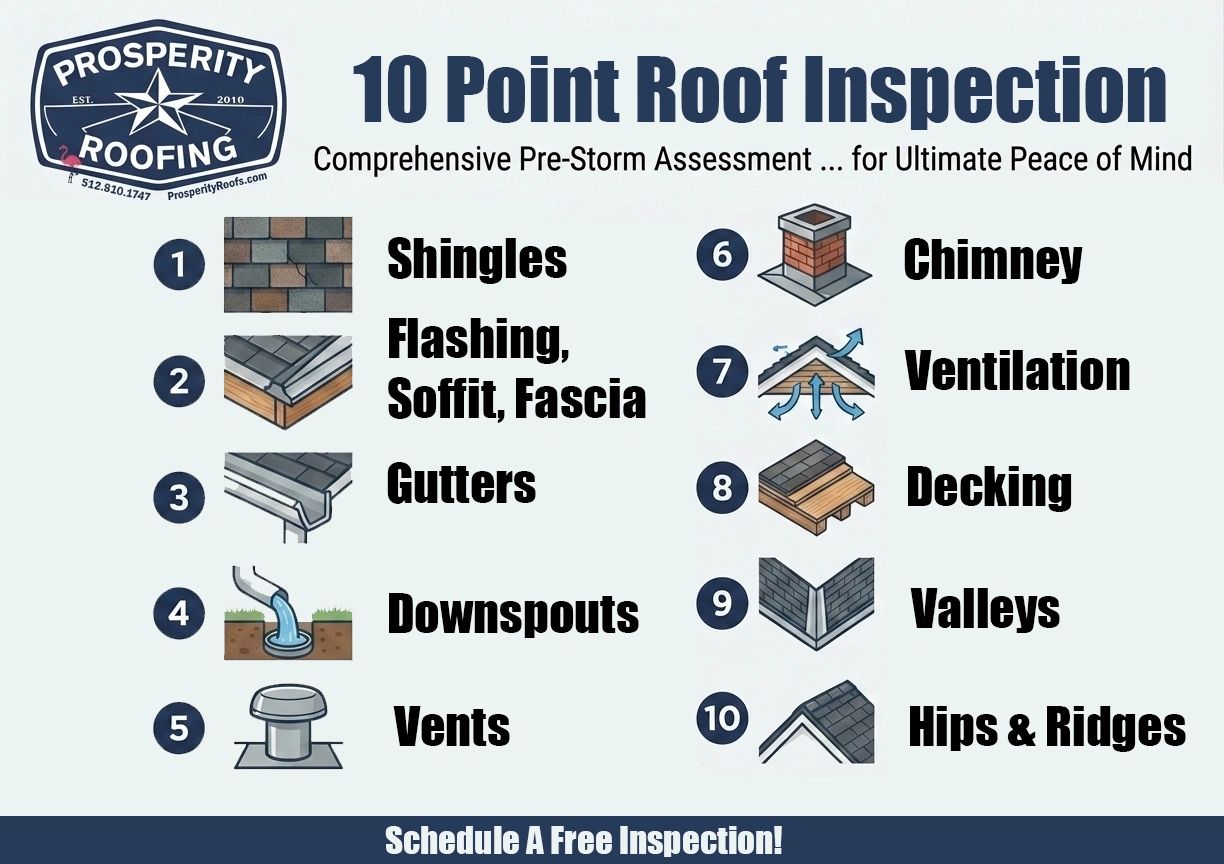
What a Proper 10-Point Pre-Storm Roof Inspection Covers
A quick glance from the driveway isn’t an inspection. A comprehensive pre-storm assessment checks every potential failure point and code requirement on your roof assembly:

1. Shingle Integrity (The 10×10 Test Square)
We chalk out test squares on weather-facing slopes to document current granule retention and prove zero pre-existing wind creases or hail bruises exist.
2. Ventilation Systems
Proper attic ventilation prevents shingles from baking from the inside out in the 100°F+ Austin summer heat. Documenting clean, unblocked ventilation stops carriers from blaming hail damage on “thermal blistering.”
3. Gutters & Debris Flow
We verify gutters are clear and securely attached. Post-storm, this helps prove that gutter dents were caused by hail impacts rather than ladder marks or pre-existing wear.
4. Downspouts
Ensuring downspouts are properly discharging water away from the foundation and fascia board establishes that pre-storm drainage was fully functional.
5. Roof Vents & Soft Metals
Soft metals (box vents, turbine housings, A/C condenser fins) show hail damage long before shingles do. Documenting that these metals are 100% dent-free before a storm guarantees the carrier can’t claim prior hail events.
6. Chimney & Wall Flashing
Checking step flashing, counter-flashing, and chimney saddles ensures vertical intersections are sealed, preventing carriers from blaming post-storm interior leaks on faulty seals.
7. Soffit & Fascia
We inspect wood structural components around the perimeter to verify there is no existing rot or water damage prior to storm winds tearing at the roof edges.
8. Decking Integrity & Code Compliance
In older Austin neighborhoods (like Bouldin Creek, Hyde Park, or Crestview), homes often have original 1×6 or 1×8 plank decking. If gaps between planks exceed 1/4 inch, current IRC Section R905.2.1 and manufacturer specs require a full OSB/plywood redeck under Ordinance and Law coverage. Identifying this early prepares you for necessary code upgrades during a future replacement.
9. Valleys
Valleys handle the highest volume of water on your roof. Documenting that valleys are clean and structurally sound prevents carriers from claiming post-storm leaks were caused by “leaf backup.”
10. Hips & Ridge Caps
We test the tar-seal adhesion on ridge caps. Proving caps are fully sealed pre-storm eliminates adjuster arguments that wind-blown caps were caused by “poor installation.”
Local Austin Codes & Insurance Supplements: Why Details Matter
When a storm hits, getting a roof replaced isn’t just about replacing shingles—it’s about bringing the roof up to modern building codes. City of Austin amendments enforce strict standards under the International Residential Code (IRC):
- Drip Edge Metal (IRC R905.2.8.5): Drip edge is required at all eaves and rakes. Because underlayment must be woven over the eave metal and under the rake metal, existing drip edge cannot be “detached and reset” without destroying it. The insurance carrier owes for full replacement.
- Solid Sheathing / Decking (IRC R905.1 & R905.2.1): Nailing shingles over plank deck gaps larger than 1/4 inch voids manufacturer warranties. Documenting plank decking pre-storm allows us to supplement the carrier for new sheathing under your policy’s Ordinance and Law clause.
Protect Your Investment Before the Next Austin Storm
Waiting for hail to fall before thinking about your roof puts all the leverage in the insurance company’s hands. A date-stamped, professional 10-Point Pre-Storm Inspection Report locked in your files ensures that when severe weather hits Central Texas, your claim is approved quickly, fairly, and in full.
Don’t wait for the skies to turn gray. Contact Prosperity Roofing today at 512-810-1747 or visit prosperityroofs.com to schedule your free, comprehensive pre-storm assessment.
